
Home ↣ Buy an Electrical Business
Buy an Established Electrical Business in British Columbia
An established electrical company may provide a buyer with trained electricians, active customer relationships, recognized qualifications, service vehicles, estimating systems and an operating platform that would take years to build independently.
Trades Business Broker helps qualified buyers identify and evaluate electrical contractors throughout British Columbia. Opportunities may include service-focused firms, commercial contractors, industrial specialists, building-automation companies, low-voltage integrators and businesses that combine electrical work with HVAC, mechanical or renewableenergy services.
The right acquisition must fit your technical background, management capacity, financing structure, preferred region and tolerance for project, labour and compliance risk. Our role is to help you approach that decision confidentially and with appropriate commercial discipline.

Why Buy an Existing Electrical Business?
Immediate Operating Capacity
Qualified Workforce
Established Customer and Referral Channels
Backlog and Service Revenue
Systems, Fleet and Technical Assets
Electrical Businesses Buyers May Consider
- Residential service and renovation electrical contractors
- Commercial tenant-improvement and service companies
- Industrial electrical and controls contractors
- Institutional, municipal and infrastructure contractors
- Building-automation, controls and energy-management firms
- Low-voltage, data, communications, security and fire-alarm integrators
- Generator, backup-power and power-quality specialists
- EV-charging and renewable-energy electrical contractors
- Maintenance-focused service businesses
- Mixed electrical, HVAC, mechanical or general contracting companies
Each operating model has a different revenue profile, qualification requirement, working-capital need and risk structure. A buyer should select a business model that fits both experience and available management resources.

What Makes a Strong Electrical Acquisition?
1. Sustainable Normalized Earnings
Review normalized EBITDA or seller’s discretionary earnings, depending on company size. Test adjustments carefully and distinguish repeatable operating profit from one-time projects, owner-specific advantages or unusually favourable periods.
2. Balanced Revenue Sources
A mix of service, maintenance, renovation, retrofit and project work may reduce dependence on a single sector. Buyers should examine exposure to new construction, a small group of general contractors, one major facility or a single referral source.
3. Transferable Qualifications and Permits
Confirm which licences, registrations, permits, certifications and supervisory responsibilities are held by the seller or key employees. Determine what must be replaced, transferred or re-established after closing.
4. Capable Workforce and Labour Pipeline
Review employee tenure, wage structure, apprenticeship mix, union status where applicable, productivity, overtime, training and retention risk. A strong company should not depend entirely on one master electrician, estimator or foreperson.
5. Reliable Estimating and Job Costing
Accurate estimating, labour tracking, purchasing controls, change-order discipline and project close-out procedures are central to margin quality. Weak job costing can hide losses until late in a project.
6. Manageable Owner Dependence
Understand whether the seller personally holds qualifications, estimates all work, controls customer relationships, supervises projects or resolves technical issues. Any dependency should be reflected in transition planning and valuation.
7. Customer and Project Diversity
Review concentration by customer, contractor, sector, project and geography. High concentration is not automatically disqualifying, but it must be understood and reflected in price, structure and risk management.
8. Strong Safety and Compliance Record
Assess WorkSafeBC standing, safety programs, incident history, training, permits, inspection records, insurance claims and any outstanding regulatory matters. Buyers should engage appropriate advisers for technical and legal review.
9. Appropriate Fleet, Tools and Inventory
Inspect vehicles, testing equipment, lifts, specialty tools, inventory and leased assets. Confirm maintenance history, financing, ownership and expected replacement costs.
10. Realistic Growth Path
Potential growth may come from expanding service work, maintenance programs, controls, EV charging, energy retrofits, recurring facility work or new geographic coverage. Growth opportunities should be practical, not speculative.
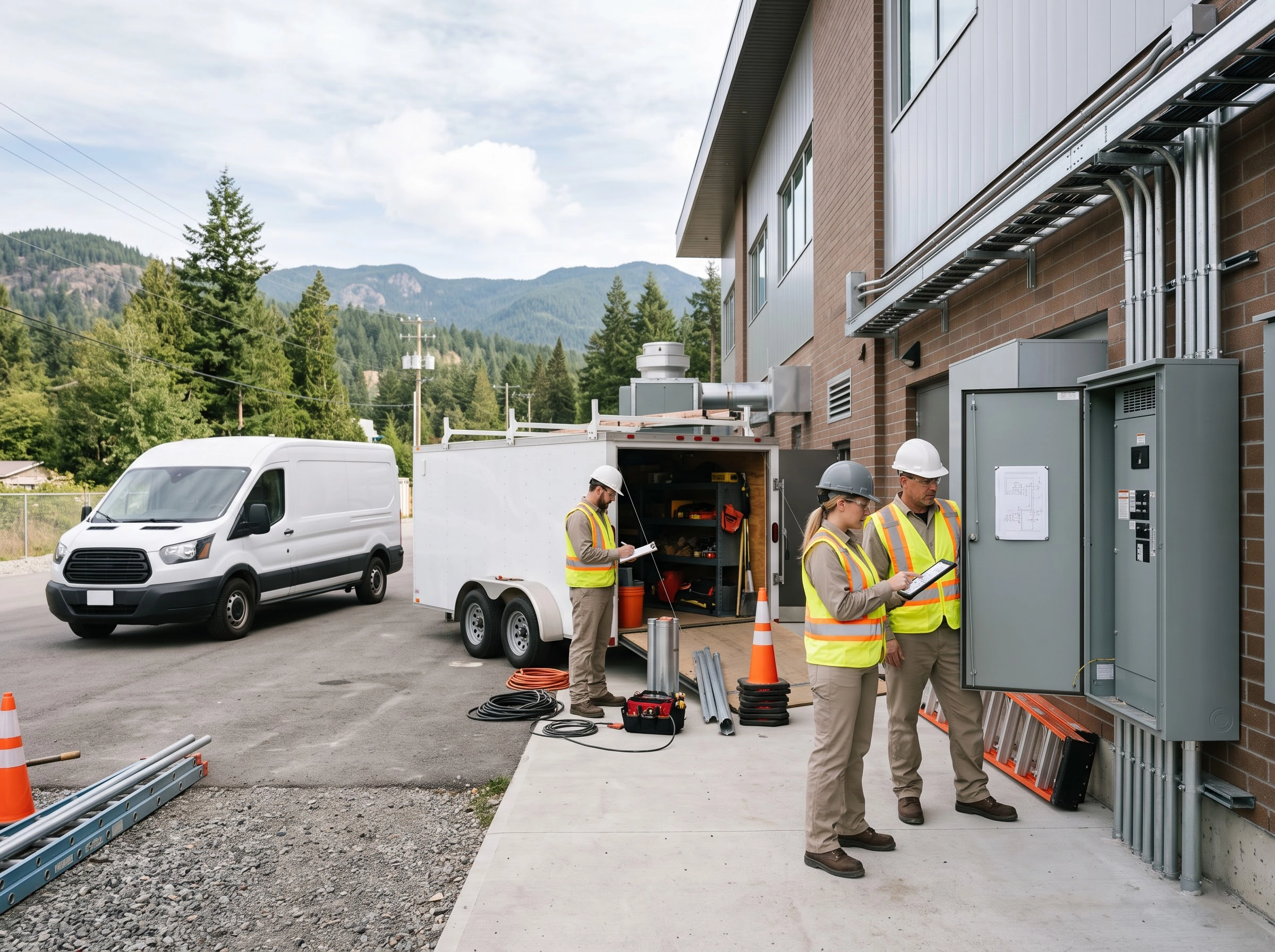
Service, Project and Specialty Electrical Companies
Service and Maintenance Contractors
Commercial and Institutional Contractors
Industrial Electrical and Controls
Low-Voltage, Data and Building Systems
EV Charging and Energy Transition Services
Key Financial and Operational Metrics to Review
- Normalized EBITDA or seller’s discretionary earnings
- Gross margin by service line, customer type and project class
- Service revenue compared with project and new-construction revenue
- Backlog by completion date, margin, customer and contract status
- Work in progress, percentage-of-completion assumptions and under- or over-billings
- Change orders, retainage, disputed invoices and unapproved extras
- Revenue and gross profit per electrician or field crew
- Billable utilization, overtime, call-backs and warranty work
- Accounts receivable aging, bad debt and collection practices
- Customer, general-contractor, supplier and referral concentration
- Fleet, tool and equipment replacement requirements
- Inventory levels, obsolete material and purchasing commitments
- Working-capital needs and seasonality
- Insurance claims, safety incidents and compliance costs
No single metric establishes value. The consistency, quality and transferability of earnings are more important than headline revenue

How Electrical Businesses Are Commonly Valued
Privately held electrical businesses are often considered using a multiple of normalized earnings, with the appropriate approach depending on size, management depth, asset intensity, revenue quality, backlog, customer concentration, qualifications and risk. Smaller owner-operated companies may be assessed using seller’s discretionary earnings, while larger firms with management depth are more commonly evaluated using EBITDA.
Asset value may also matter where the business owns significant fleet, equipment or inventory. Revenue alone is rarely sufficient because two contractors with similar sales can have very different margins, working-capital needs, backlog quality and owner dependence.
Buyers should not rely on generic industry multiples without understanding the assumptions behind them. A defensible valuation requires business-specific normalization, risk analysis and clarity regarding included assets, working capital, debt and transaction structure.

Financing an Electrical Business Acquisition
Acquisition financing may include buyer equity, bank or credit-union financing, Canada Small Business Financing Program eligibility where applicable, seller financing, earn-outs or a combination of sources. Availability and terms depend on the business, buyer, collateral, cash flow and transaction structure.
- Prepare a realistic personal financial statement and source-of-funds summary
- Understand how much working capital will be required after closing.
- Separate purchase-price financing from fleet, equipment and operating-line needs.
- Model debt service under conservative revenue and margin assumptions.
- Confirm whether bonding, insurance and supplier credit will remain available after ownership changes
- Avoid committing to a structure before receiving tax, legal and financing advice.
Electrical Business Due Diligence
Due diligence should be proportionate to the size and complexity of the company. It is not limited to reviewing financial statements.
Financial Review
- Historical financial statements and tax returns
- Monthly sales and margin trends
- Normalization adjustments and owner compensation
- Accounts receivable, retainage and bad debts
- Work in progress and backlog schedules
- Capital expenditure and working-capital requirements
Operational Review
- Estimating, dispatch, purchasing and job-costing systems
- Crew capacity, utilization and supervision
- Fleet, tools, inventory and leased assets
- Warranty, call-back and rework history
- Supplier terms and credit arrangements
- Owner responsibilities and transition requirements
Legal and Contract Review
- Customer and subcontract agreements
- General-contractor terms, indemnities and payment provisions
- Change orders, claims and disputed projects
- Lease, financing and equipment agreements
- Employee, union and independent-contractor arrangements
- Intellectual property, trade names and software licences
Licensing, Safety and Compliance Review
- Provincial and municipal registrations and licences
- Permits, inspections and technical qualifications
- WorkSafeBC standing and safety program
- Insurance coverage and claims history
- Environmental and hazardous-material obligations where relevant
- Any outstanding orders, complaints or regulatory matters
Buyers should use qualified legal, accounting, financing, insurance and technical advisers. Trades Business Broker coordinates the transaction process but does not replace independent professional advice.
Our Process for Buying an Electrical Business
Step 1 – Confidential Buyer Consultation
We discuss your experience, qualifications, preferred geography, budget, available equity, financing strategy, desired role and acquisition criteria.
Step 2 – Buyer Registration and Confidentiality
Before confidential information is released, buyers complete the required registration and confidentiality documentation. Evidence of financial capacity or financing readiness may be requested.
Step 3 – Opportunity Screening
We compare your criteria with available electrical businesses and provide appropriate high-level information. The objective is to avoid wasting the buyer’s or seller’s time on a poor fit.
Step 4 – Confidential Information Review
Qualified buyers may receive a confidential information package covering operations, financial performance, workforce, customers, assets and transaction expectations.
Step 5 – Seller Meeting and Operational Discussion
Where appropriate, the buyer meets the seller to understand the company, owner role, employees, qualifications, project pipeline, customers, systems and transition requirements.
Step 6 – Offer and Negotiation
A well-structured offer addresses price, deposit, financing, due diligence, working capital, included assets, transition, restrictive covenants, employees and material closing conditions.
Step 7 – Due Diligence and Financing
The buyer and advisers verify financial, legal, tax, operational, licensing, safety, customer, employee, asset and contractual information while finalizing financing and transaction documents.
Step 8 – Closing and Transition
The parties complete closing conditions and implement an agreed transition plan covering employees, customers, suppliers, permits, qualifications, project handover and seller support.
Common Buyer Mistakes
- Focusing on revenue without understanding margin, cash flow and working-capital requirements.
- Assuming backlog is profitable, fully contracted or transferable without verification.
- Underestimating the importance of the seller’s licence, estimating ability or customer relationships.
- Ignoring retainage, under-billings, change orders and unresolved project claims.
- Failing to assess employee retention and the availability of qualified field leadership.
- Overvaluing speculative growth in EV charging, automation or electrification services.
- Treating equipment value as separate from necessary replacement capital.
- Relying on verbal assurances rather than professional due diligence and written transaction terms.
- Contacting employees or customers before an agreed communication plan is in place.
Who This Page Is For
- Licensed electricians seeking an established platform
- Electrical contractors expanding into a new region or service line
- Mechanical, HVAC or construction groups pursuing a strategic acquisition
- Experienced operators seeking a management-led acquisition
- Family-business successors and management buyout candidates
- Qualified acquisition entrepreneurs with an appropriate technical and management plan
An electrical company is not a passive investment. Buyers must have, retain or recruit the technical qualifications and operational leadership needed to run the business safely and lawfully
Confidentiality Matters
Employees, customers, suppliers and competitors may react negatively to premature disclosure of a potential sale. Qualified buyers should not contact the seller’s staff, customers, landlord, contractors or suppliers without written authorization and a coordinated process.
Confidentiality protects both parties and helps preserve the value of the business while the opportunity is being evaluated.
Frequently Asked Questions
Ownership and technical licensing requirements depend on the company, services and jurisdiction. A buyer who is not personally qualified may need to retain appropriately licensed and authorized personnel. This should be confirmed with legal and regulatory advisers before proceeding.
Price depends on normalized earnings, management depth, workforce, customer concentration, backlog, assets, working capital, owner dependence and risk. Revenue alone is not a reliable indicator of value.
They can involve greater working-capital, backlog, retainage, change-order and execution risk, but quality varies by company. Service businesses may offer shorter job cycles and repeat customers, while project contractors may have larger contracts and stronger backlog. Due diligence should reflect the operating model.
The transaction must address any qualifications, permits or authorizations connected to the seller. Buyers should determine what can transfer, what must be replaced and what conditions must be satisfied before ownership changes.
Potentially. Financing depends on buyer equity, credit, experience, business cash flow, collateral and transaction structure. Working capital and bonding requirements should be considered alongside the purchase price
Backlog can provide visibility, but buyers must verify contract status, expected margin, completion costs, labour availability, change orders, cancellation rights and working-capital requirements. Unprofitable backlog can reduce value.
Usually not at the beginning. Employee communication is typically planned for an appropriate stage of the transaction to protect confidentiality and retention.
We may know of confidential or upcoming opportunities and can also record a qualified buyer’s acquisition criteria. Availability cannot be guaranteed.
Most buyers should engage a lawyer and accountant. Depending on the company, financing, tax, insurance, bonding, safety, environmental and technical specialists may also be appropriate.
Timing varies based on readiness, financing, due diligence, negotiations, licensing, third-party approvals and transaction complexity. Buyers should avoid relying on a fixed timeline before the opportunity is understood.
Looking for an Electrical Business in British Columbia?
Register confidentially to discuss your acquisition criteria, financial capacity, preferred region and operating background. We will help determine whether available opportunities may be suitable for further review.